

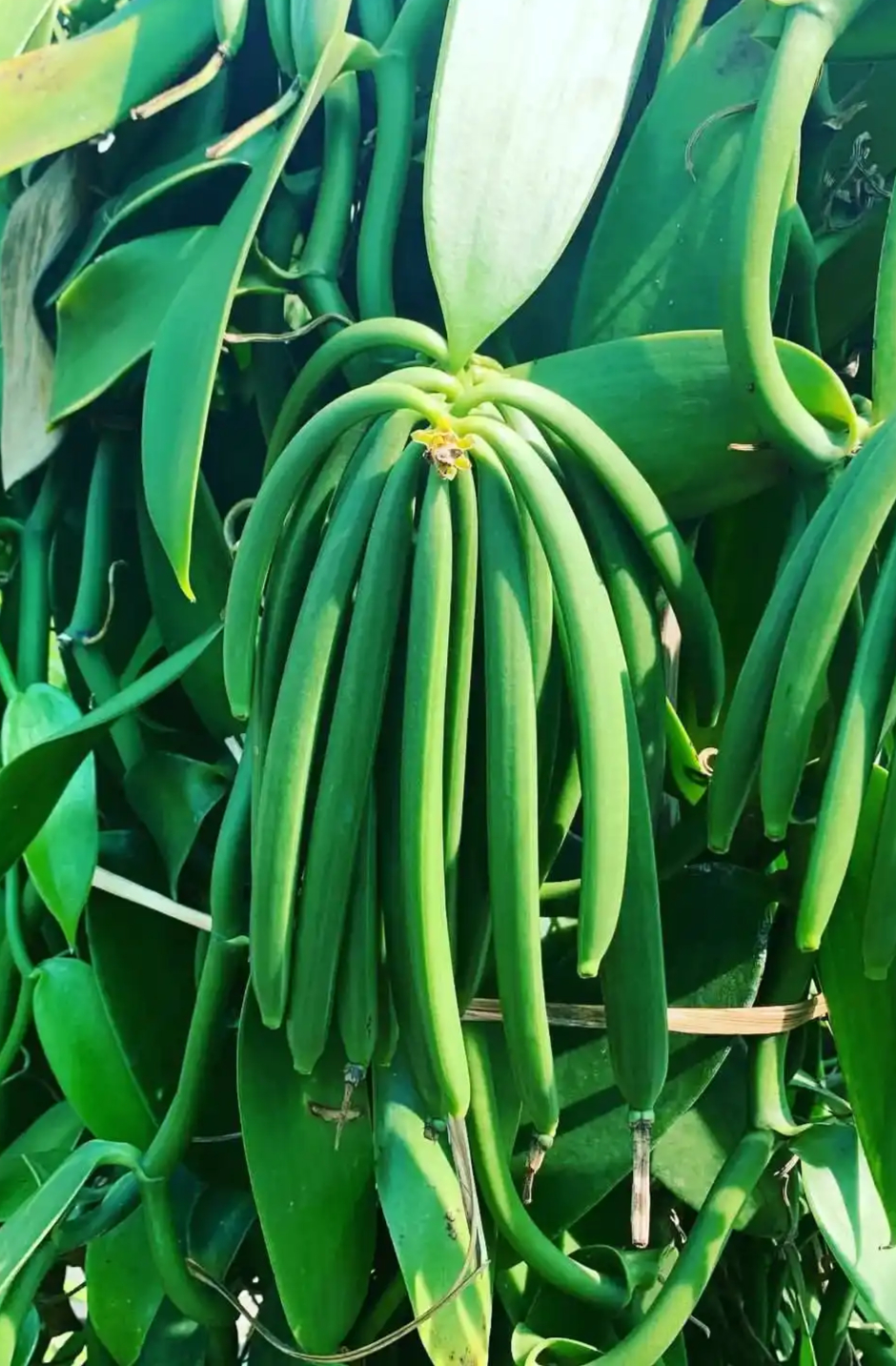
There is a spice found in nearly every kitchen across the world — one whose global production was once almost entirely mastered by a single island. Bourbon vanilla, named after La Reunion’s former designation as the Île Bourbon, is to this day considered among the finest and most fragrant in existence. And the East Coast of the island, centred on Sainte-Rose, is precisely where this extraordinary crop finds its most natural home.
Here is everything you need to know before setting out to visit a vanilla plantation.
Bourbon Vanilla: A Réunionnais Story
From Mexico to the Island of Bourbon
Vanilla is a tropical orchid originating in Mexico. For centuries, only a small native Mexican bee could pollinate it naturally, making its cultivation impossible outside its place of origin. Louis XIV, a devoted admirer of the spice, repeatedly attempted to introduce it into the French colonies without success. It was not until 1819 that plants finally arrived on the island of Bourbon, brought by Captain Philibert and the botanist Perrotet. Without the native bee, however, the flowers produced no pods. The crop remained a curiosity, confined to a handful of botanical gardens.
Edmond Albius: The 12-Year-Old Genius Who Changed History
Everything changed in 1841. A twelve-year-old enslaved boy from La Réunion named Edmond Albius discovered, entirely on his own, the technique of artificial vanilla pollination. The gesture is precise, almost surgical: using a slender bamboo sliver or a blade of grass, the pollen is manually transferred from the stamen to the pistil of the flower, which remains open for only a single morning. Edmond devised this method by studying other orchid species. In doing so, he transformed a botanical curiosity into a global industry.
This technique is still used today in every vanilla plantation on Earth. La Réunion has honoured Edmond Albius — long denied recognition because of his enslaved status — by naming a street after him in Saint-Denis and erecting a bust in Sainte-Suzanne, his home commune.
The Island of Bourbon’s Reign over the World Market
In the second half of the nineteenth century, La Réunion alone produced 75% of the world’s vanilla. The spice even featured on the official coat of arms of the island, alongside sugar cane. Although Madagascar has since taken over in terms of volume, Bourbon vanilla from La Réunion remains an unrivalled qualitative benchmark for the world’s finest pastry chefs and chocolatiers.
Why the East Coast Is the Heart of Réunionnais Vanilla
Vanilla is a demanding plant. It requires warmth, consistent humidity, partial shade and rich volcanic soil. The East Coast of La Réunion — particularly the zone encompassing Sainte-Rose, Bras-Panon and Saint-André — fulfils every one of these conditions to perfection. It is the most rain-soaked part of the island, sheltered by the first buttresses of Piton de la Fournaise, cloaked in tropical forest and underlain by soils derived from successive lava flows over the centuries.
The South Sauvage, around Saint-Philippe, offers similarly favourable conditions and is home to several plantations as well.
The vanilla vine can grow up to 15 metres in height, twining around host trees — often endemic bois de couleur species — and flowering between October and December. Each flower must be pollinated by hand on the very morning it opens, or it is lost. After pollination, 9 months must pass before the pod reaches maturity, followed by several additional months of curing and preparation before the vanilla reaches its final aromatic form. From flower to fragrant pod: 18 months of work in total.
What Exactly Is Bourbon Vanilla from La Réunion?
Bourbon vanilla technically refers to the Vanilla planifolia variety cultivated across the former territories of the island of Bourbon — La Réunion, Madagascar and the Comoros. Yet the unique pedoclimatic conditions of La Réunion, combined with generations of local expertise, endow it with specific characteristics that set it apart:
- One of the highest vanillin concentrations found anywhere in the world
- Frost crystals (crystallised vanillin) visible on superior-grade pods
- A complex aromatic profile — at once floral, woody and faintly spiced
- A plump, supple pod of deep, almost black-brown
These qualities are precisely why Réunionnais vanilla is sought out by leading pastry chefs and chocolatiers, who prize it above all others for the most refined preparations.
Vanilla Plantations to Visit: Our Selection
Not all of the island’s vanilla plantations are open to visitors. Below are the best, all reachable within a day from Villa Bigaradier.
1. Plantation Vanilla Bourbon — Sainte-Rose ⭐ Our Top Pick
The closest to the villa, and arguably the most beautiful on the island.
Nestled in the highlands of Sainte-Rose at 300 metres altitude, the Plantation Vanilla Bourbon run by Maryse Mounier is an exceptional estate. The site spreads across 5 hectares of primary forest, established on an ancient lava flow dating from 1708. Today it is home to 6,000 vanilla vines, a palm grove, a Creole orchard, and an extraordinary wealth of endemic species — orchids, giant ferns, indigenous trees.
The guided tour lasts over 2 hours and takes you deep into the forest, far from the world beyond. Maryse or her guide Vincent walk you through every stage of the cultivation process: planting the vine, hand-pollinating each flower, harvesting, curing and preparing the pods. The tec-tec, a charming endemic bird found only on La Réunion, accompanies you with cheerful curiosity throughout the walk.
The atmosphere is the antithesis of mass tourism. This is a real, working plantation, run with passion and without chemical inputs. Visitor reviews speak with one voice: an unforgettable experience.
| Address | Petit Brûlé, 97439 Sainte-Rose |
| Distance from the villa | 15 min by car |
| Price | €7 / adult |
| Opening hours | Mon–Sat, tours from 9 am and 1 pm — by appointment |
| Contact | vanille-reunion.fr |
| What to bring | Walking shoes or trainers are required |
2. Coopérative Pro Vanille — Bras-Panon
45 minutes north of the villa, the Pro Vanille cooperative in Bras-Panon is the meeting point of the East Coast’s vanilla producers. This is not a plantation in the strict sense, but a cooperative bringing together multiple growers, allowing visitors to observe and purchase premium-grade pods directly from the source, at fair prices.
Guided tours of approximately 40 minutes run throughout the day from 9 am to 4:15 pm, with no advance booking required. It is the ideal place to understand the collective curing process and bring home a supply of quality vanilla — the pods sold on site are vastly superior to anything found in a supermarket.
| Address | Bras-Panon (northern East Coast) |
| Distance from the villa | 45 min northward |
| Price | €6 / adult |
| Opening hours | Daily, 9 am–4:15 pm, no appointment needed |
3. Plantation Vanille Rouloff — Saint-André
A little further north, in Saint-André, the Rouloff family welcomes visitors to a genuine working family plantation. The atmosphere here is particularly authentic — you are stepping into the daily reality of a Réunionnais vanilla grower, not a staged tourist presentation. Affordable admission (€4) and warm, genuine hospitality.
| Address | Saint-André |
| Distance from the villa | 1 hour northward |
| Price | €4 / adult |
4. Domaine du Grand Hazier — Sainte-Suzanne
In Sainte-Suzanne, the Domaine du Grand Hazier combines a vanilla plantation visit with a tour of a nineteenth-century Creole estate listed as a Historic Monument. An ideal outing if you wish to pair the architectural heritage of the island’s colonial era with the living craft of vanilla cultivation.
| Address | Sainte-Suzanne |
| Distance from the villa | 1h15 northward |
| Price | €5 / adult |
When to Buy and How to Choose
Available Forms
- Whole fresh pods: the finest option for cooking, stored in an airtight jar away from light
- Vanilla powder: convenient, though less intensely fragrant than whole pods
- Liquid extract: best suited to large-scale baking and industrial use
- Artisan vanilla sugar: easy to make at home — simply place a pod in a jar of sugar for three weeks
How to Recognise a Quality Pod
A superior-grade Bourbon vanilla pod is supple and plump, deep brown to almost black, and sometimes dusted with fine, brilliant crystals — crystallised vanillin, the hallmark of high aromatic concentration. It should bend without breaking. A dry, rigid or dull pod is either old or poorly cured.
Where to Buy
Beyond the plantations themselves — always the best option — the weekly markets of the East Coast (notably the Sainte-Rose market, held on Friday mornings) regularly feature pods from local growers. Avoid the souvenir shops at the airports, where quality tends to be inversely proportional to the price on the label.
What Vanilla Tells You About La Réunion
Beyond the spice itself, vanilla runs like a thread through the entire history of the island. It is bound up with slavery and its abolition — Edmond Albius invented his technique just two years before emancipation in 1848. It is bound up with the endemic forest, whose trees serve as living supports for the vines. It is bound up with the volcano, whose fertile soils have nourished the plants for centuries.
To visit a vanilla plantation in Sainte-Rose is to reach into that history and hold it in your hands. It is also to meet women and men who dedicate their lives to pollinating flowers one by one, each morning between October and December, tending a plant whose fragrance will take another eighteen months to fully unfold.
Villa Bigaradier is ideally positioned for visits to the East Coast’s vanilla plantations. Plantation Vanilla Bourbon is just 15 minutes away by car. We are delighted to share Maryse’s contact details and advise you on the best places to buy your vanilla directly from the grower.
 Good news!