

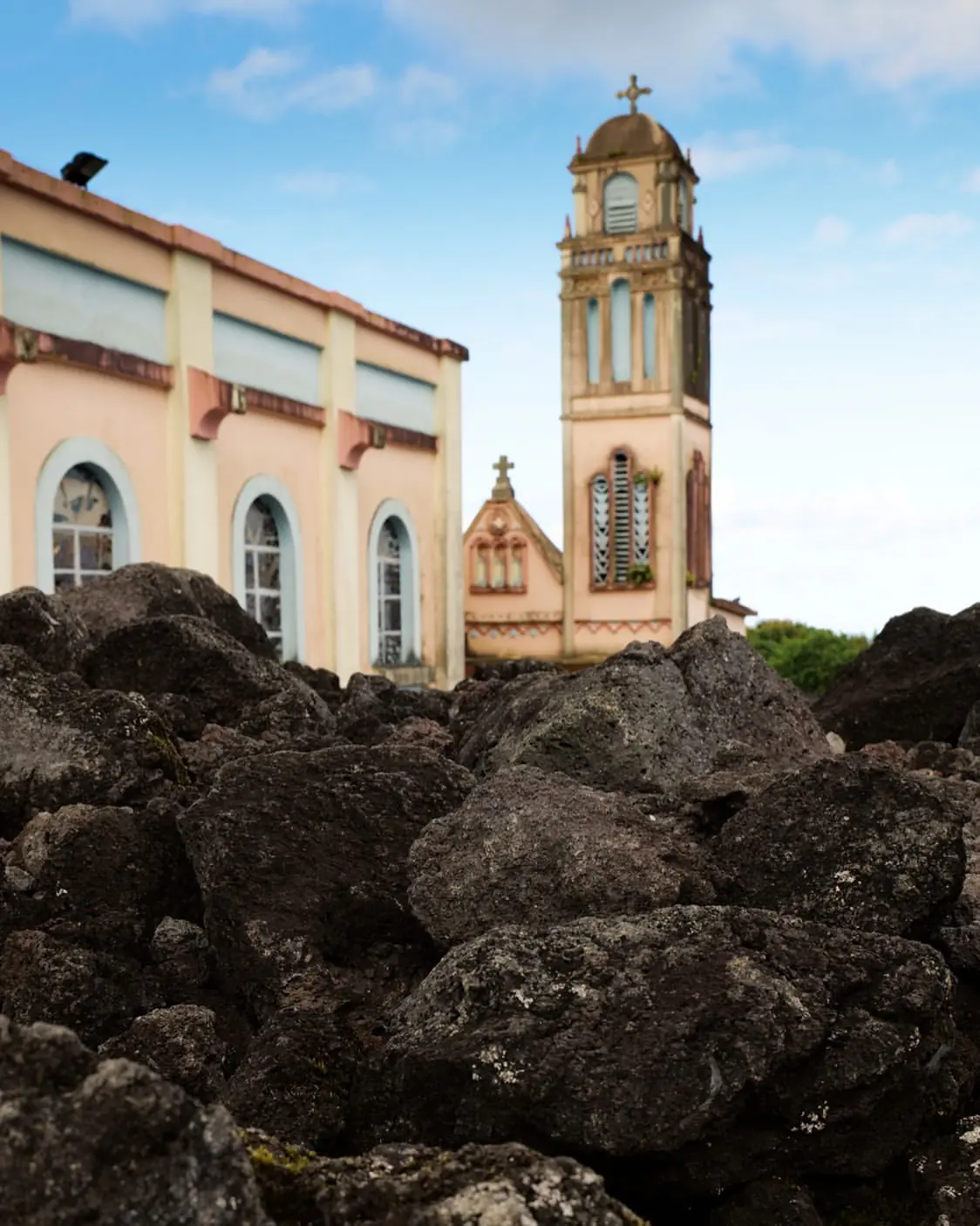
Five minutes on foot from Villa Bigaradier, a small pink church stands amid a field of black lava. Its name is Notre-Dame des Laves, and its story is one of the most haunting in the whole of La Réunion. In April 1977, a torrent of molten rock pouring down the flanks of Piton de la Fournaise encircled it, set its doorway ablaze, and grazed its nave — then stopped. The church was still standing. The rest of the village was not.
Whether or not you are a believer, this place unsettles and captivates in equal measure. Here is everything you need to know before you visit.
A Church Born in 1927, at the Foot of the Volcano
The story of Notre-Dame des Laves begins long before 1977. It was in 1927 that the residents of Piton Sainte-Rose built a first chapel in this quarter of the East Coast, originally dedicated to the Infant Jesus of Prague. In a village living under the permanent threat of Piton de la Fournaise — one of the most active volcanoes on Earth — this place of worship quickly became the heart of community life.
The building was enlarged in 1935, then entirely rebuilt in 1952 after a cyclone caused severe damage. Its original style was nonetheless preserved: the graceful Creole Art Deco aesthetic, with its delicately painted pink façade and characteristic ornamental details. When Piton de la Fournaise erupted in March 1977, it was this 1952 church that lay directly in the path of the lava.
Easter Weekend 1977: When Lava Swept Through the Village
On 24 March 1977, Piton de la Fournaise awakens. Initially confined within the Enclos Fouqué caldera, the eruption takes a dramatic turn on 5 April when new fissures tear open outside the enclosure, on the upper slopes above Sainte-Rose. It is the first time since the area was settled that such an event has occurred. The people of La Réunion realise that day that the volcano can reach their villages.
Two distinct flows form. One heads toward Bois-Blanc — it stops just metres short of the village. The other bears down directly on Piton Sainte-Rose. The 600 residents are evacuated in a hurry.
On the night of 9 April, the lava front enters the village. It burns a dozen wooden houses, cuts the RN2 and pours into the Indian Ocean by early morning. First passage: the church is spared.
But on the evening of 13 April, a new fissure opens lower on the slope. A second lava torrent races down the hillside at 80 km/h, its front standing 7 to 8 metres high. At 7:15 pm, the lava reaches the church forecourt. The doorway bursts into flames. The stained-glass windows shatter from the heat — the temperature of the molten rock exceeds 1,000 °C at this point. Lava enters the nave to a depth of 3 metres, setting pews alight. Then it stops. Another arm flows around the church, destroys a further 34 houses, engulfs the gendarmerie and petrol station, and reaches the ocean at 9:30 pm.
The eruption ends on 15 April 1977. The church is still standing. What many will call a miracle has been inscribed in the collective memory of the whole island ever since.
What You Will See Today
Following its restoration in 1979, the church receives a new name that tells its own story: Notre-Dame des Laves. It has since worn the traces of the eruption proudly, like scars transformed into emblems.
The Staircase Carved from Lava
The entrance itself is fashioned from the 1977 lava, now solidified, cut and shaped into steps. Every footfall on the way to the doorway is a step across history.
The Stained-Glass Windows by Guy Lefèvre
The original windows having shattered in the heat, Réunionnais master glassmaker Guy Lefèvre created new stained-glass panels in 1979 depicting the lava flow encircling the building. He also completed the large fresco placed behind the altar in 1982. These works reward close attention — they recount the event with a precision and emotional power that is genuinely rare.
The Virgin with the Parasol
Inside the church stands an old statue, known as the Virgin with the Parasol — so named after a craftsman fashioned a small shelter to protect her from the East Coast’s relentless rainfall. Legend has it that a vanilla planter commissioned the statue after lava had miraculously spared his fields. The statue itself was bypassed by several lava flows over the decades, before finally being brought inside the church for safekeeping.
The Métisse 77 Statue
Facing the church, unveiled in September 2018, a sculpture created by four Réunionnais artists depicts a woman, a cross around her neck, her gaze turned toward the volcano. It is called Métisse 77, and embodies the grief of the people of Sainte-Rose during the 1977 eruption.
The Interpretation Centre
Opposite the church, housed within the former gendarmerie partially destroyed by the lava, a free permanent exhibition recounts the 1977 eruption through photographs, press cuttings and a period documentary film. It is open Tuesday to Saturday, from 9 am to 12 noon and 1 pm to 5 pm. Admission is free.
Practical Information
| Address | RN2, Piton Sainte-Rose, 97439 Sainte-Rose |
| Distance from the villa | 5 minutes on foot (500 m) |
| Access | Unrestricted, free admission |
| Permanent exhibition | Tuesday–Saturday, 9 am–12 pm / 1–5 pm — free admission |
| Parking | Free on site |
| Suggested duration | 45 min to 1 hour (church + exhibition + statue) |
What You Are Rarely Told
Notre-Dame des Laves is often presented as little more than a tourist curiosity. In reality, it is an active pilgrimage site. Processions are held each year in memory of the eruption, and worshippers travel from across the island to pray here.
The church is open to all, believers and non-believers alike. It does, however, remain an active place of worship — a degree of quiet respect is appropriate during your visit.
Take time to walk along the 1977 lava flow visible from the seafront, downstream from the Piton Sainte-Rose fitness trail. Nearly fifty years on, it remains almost entirely intact, barely dusted with a few casuarina trees as nature slowly reclaims its ground. Approaching the ocean’s edge, the sheer width of the flow at the point where it met the sea puts the scale of the event into perspective.
Combining Your Visits
Notre-Dame des Laves fits naturally into a full day exploring the East Coast from the villa:
- Morning: visit the church and the exhibition (45 min)
- Late morning: Anse des Cascades, 3 km to the north
- Lunch: La Terrasse des deux Pitons snack bar, directly opposite the church, celebrated locally for its Réunionnais curries
- Afternoon: the Route des Laves, southward toward the Grand Brûlé and Saint-Philippe
Villa Bigaradier is located just 500 metres from Notre-Dame des Laves. From your ocean-view terrace, you look out over the very same slopes down which the 1977 lava descended. To stay here is to inhabit the living volcanic history of the island.
 Good news!